
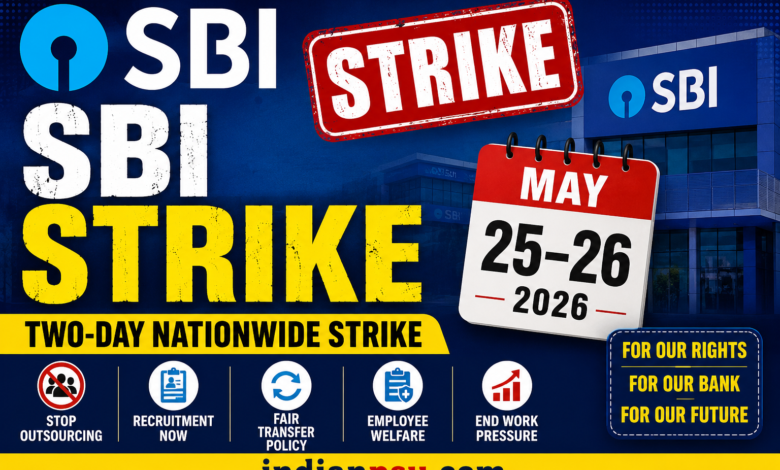
Employees of State Bank of India, India’s largest public sector bank, have announced a two-day nationwide strike over several long-pending demands. The All India State Bank of India Staff Federation (AISBISF) stated that SBI employees across the country may remain on strike on May 25 and 26. The union has also warned that if these dates coincide with a public holiday or weekend, the protest could continue until May 27.
Why Are SBI Employees Going on Strike?
According to the union, discussions with the bank management have been ongoing for a long time, but several important employee-related issues remain unresolved. As a result, employees have decided to intensify their protest.
AISBISF has placed 16 major demands before the management, with staff shortage and increasing workload emerging as the biggest concerns.
Major Reasons Behind the Strike
Severe Staff Shortage in Branches
The union claims that recruitment for messenger and support staff positions has been stalled for many years. At the same time, the number of clerical employees has continued to decline, increasing pressure on existing staff members.
Growing Dependence on Outsourcing
Employees have alleged that the bank is increasingly relying on outsourced workers for regular banking operations. According to the union, this trend threatens permanent jobs and negatively impacts both employee security and service quality.
Salary and Pension Disparity
The union stated that under the 12th Bipartite Settlement, workmen staff received a 17% salary increase, while officers effectively received nearly 22% due to additional special pay. Employees argue that this has created inequality within the organization.
Staff members are also demanding the freedom to choose their own pension fund manager under the National Pension System (NPS).
Key Demands of SBI Employees
The major demands raised by SBI employees include:
- Recruitment of adequate staff in branches
- Reduction in excessive workload
- Pension parity among employees
- End to outsourcing practices
- Better service conditions
- Reforms in promotion and transfer policies
- Improved employee welfare and security
- Freedom to choose pension fund managers under NPS
Protest Activities Throughout May
Before the strike, the union plans to conduct phased protests throughout the month of May. These activities include:
- Lunch-hour demonstrations
- Social media campaigns
- Peaceful marches
- Dharna and protest gatherings
- Submission of memorandums to MPs and government authorities
The union claims that despite continuous discussions over the last two years, no meaningful resolution has been achieved, making stronger protests necessary.
Possible Impact on Customers
If the strike proceeds as planned, banking services across SBI branches nationwide could be affected. Customers may face difficulties related to:
- Cash deposits and withdrawals
- Cheque clearance services
- Branch operations
- Customer support
- Account-related services
However, digital services such as UPI, internet banking, and mobile banking are expected to continue functioning normally.
Conclusion
The proposed SBI strike is not just about salaries or recruitment issues; it also highlights broader concerns regarding workload, outsourcing, employee welfare, and workplace equality in the banking sector. The response of the government and bank management in the coming days will be closely watched by millions of employees and customers across India